Categories
- Architecture
- Art & Illustration
- Blog
- Business
- Company
- Corporate
- Culture
- Design Agencies
- Designer
- Developer
- E-Commerce
- Education
- Entertainment
- Events
- Experimental
- Fashion
- Film & TV
- Finance
- Food & Drink
- Games
- Health
- Hotel & Restaurant
- Institutions
- Lifestyle
- Magazine
- Mobile & Apps
- Music & Sound
- Newspaper
- Organization
- Other
- Personal
- Photography
- Portfolio
- Promotional
- Real Estate
- Resource
- Social
- Sports
- Startups
- Technology
- Themes
- Web & Interactive
- Web Designer
- Web Developer
Tags
- Animation
- App Style
- Background Images
- Bootstrap
- Bright
- Canvas
- Carousel
- Clean
- Colorful
- Design
- Drupal
- Fixed Navigation
- Flat Design
- Fluid
- Fullscreen
- Gallery
- Graphic design
- Grid
- Horizontal Layout
- Icons
- Illustration
- Infinite Scroll
- Interaction
- Interaction Design
- Menu - Horizontal
- Menu - Vertical
- Minimal
- One Page
- Parallax
- Photo & Video
- Photography
- Portfolio
- Responsive
- Responsive Design
- Retro
- Scrolling
- SEO
- Social Integration
- Sound-Audio
- Storytelling
- SVG
- Texture
- Transitions
- Typography
- UI design
- Vector
- Video
- Web Fonts
- WooCommerce
- WordPress
 Previous
 Next
NextVaultion
Jay Banger
from Seychelles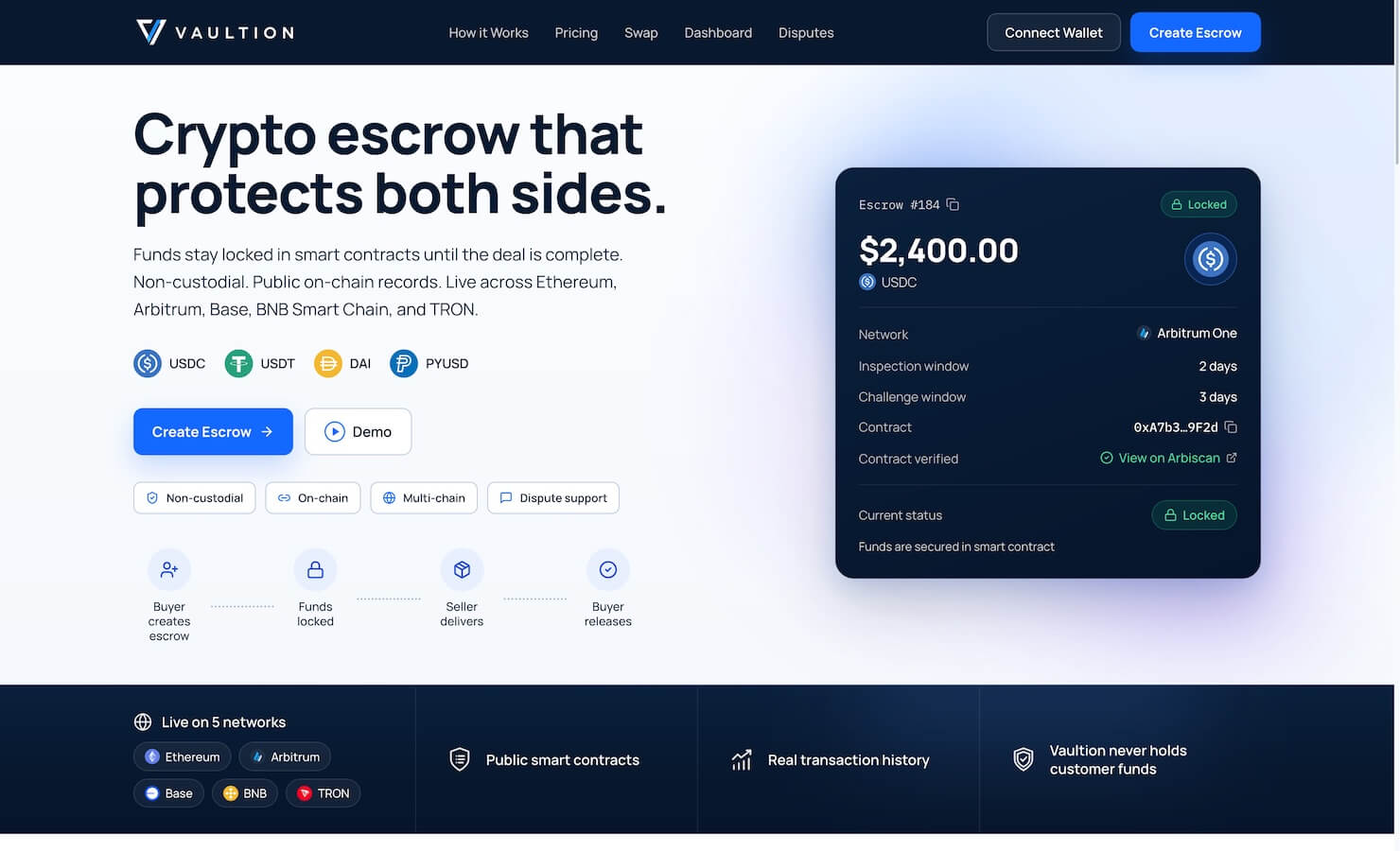
About
Vaultion removes the oldest problem in any deal between strangers: someone has to move first. Instead of trusting a person or company to hold the money, Vaultion locks the payment in a published smart contract that releases it only when the deal's terms are met. Here's how it works: A buyer funds an escrow with a stablecoin — USDC, USDT, DAI, or PYUSD — the seller delivers, and the buyer confirms to release. If the two sides disagree, the funds stay locked while an independent arbitrator decides: either Kleros, a decentralized court of randomly drawn jurors, or a Vaultion-assisted human reviewer whose ruling passes through a challenge window before any money moves. A freeze-only guardian can pause a questionable ruling but can never redirect the funds. Because nothing is custodial, no employee — not even Vaultion — can reach into an open escrow. You can pull the contract up on Etherscan, Arbiscan, or Basescan and watch the locked balance before committing a cent. Vaultion runs on Ethereum, Arbitrum One, and Base, with no signup, no identity checks, and no bank in the middle. For freelancers, OTC traders, domain sellers, and anyone settling a private deal on-chain, it turns "I hope they follow through" into a rule enforced by code.